Living in the After

When tragedy strikes, it can feel like a bomb exploding—sudden and without mercy. Life moves forward at its normal pace until the blast arrives. Shockwaves shatter, derail, and topple. Sounds become muffled. Time slows. For those at the epicenter, everything has changed. The victims find a new normal, but no one is the same living in the after.
On October 9, 2020, the quiet northeast Texas town of New Boston felt those shockwaves when news spread about the brutal murder of a young wife and mother, Reagan Michelle Hancock, and her unborn daughter, Braxlynn Sage. The basic story is easy to find in headlines, true crime episodes, and court records. The date, the address, the charges, and the verdict are all there. But nothing in those lines tells you who Reagan was. Those records don’t show the way her mother’s voice lifts as she says, “She was the best mama I’ve ever known,” or the way it catches when she talks about finding her daughter on that day. Those records don’t hold the memories her Granny has of the curly-headed spitfire who brought so much excitement into the family, nor do they capture the loss her siblings feel about not growing old with their sister.
REAGAN
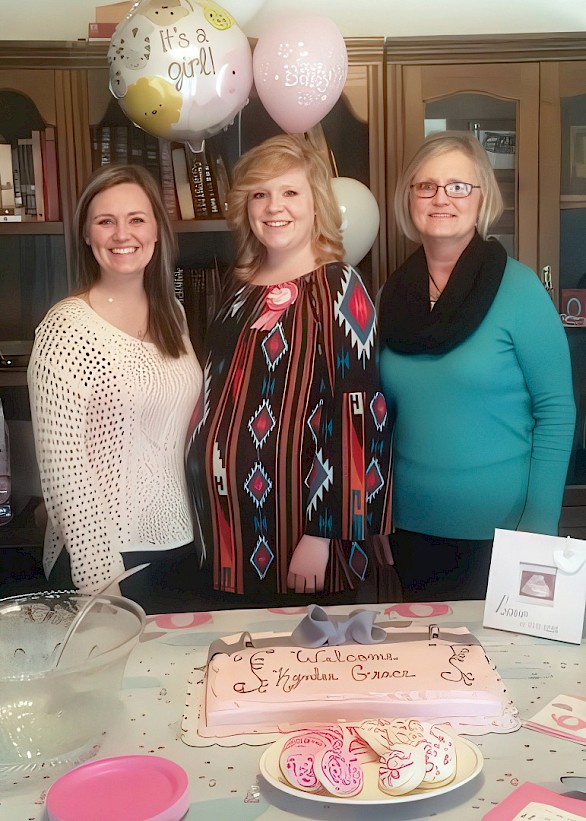
Reagan’s mother, Jessica Brookes, remembers her with a deep love and fondness. “Reagan…” she pauses, “she was a very, sweet, sweet child. Reagan didn’t care about toys,” she said. “But she loved shoes.” One of Jessica’s favorite memories is when Reagan was two or three years old. Reagan wandered off in Dillard’s while the family shopped at the mall. As they frantically searched, a store clerk directed them to the shoe department. “There she was,” Jessica recalls, shaking her head with affection. “Just standing there in the shoes like she owned the place.” Reagan was tiny but sure of herself, drawn to anything with buckles, straps, sparkles, or heels. She knew what she liked and didn’t waver.
“Reagan always had the biggest heart,” Jessica adds. “But she could be a little spitfire, too. She was sweet as sugar one minute and all attitude the next." She said it with the pride of a mother whose child was both tender and tough. “You know, she really cared about people,” Jessica said admirably. Jessica explained that her family did not prize popularity, but rather the kind of character that goes out of the way to help someone in need. She always taught her kids to be kind to everyone, no matter how much money they had or if they were outcasts. Still, Jessica reflects on this with a hint of sadness. “Sometimes,” she said, “sometimes now, I think that was a mistake.”

Reagan was the second-oldest of four in a blended family. “She was bossy,” Jessica said. “She liked to take charge.” In middle school, Reagan often left notes about her siblings’ mischief. Jessica recently found a notebook with their recorded infractions. She laughed as she read her words: “Clayton was slamming doors.” “Destiny accidentally hit Clayton.” “Hi Ma, how was your day? Well, Emily just peed in the sink.” “Oh, I remember that day,” Jessica recalled. “We had two bathrooms, but four kids. She was always the leader of the kids. She looked out for all of them.”
Reagan discovered she was pregnant at age 17. It was important to the family to support Reagan through this time without shame. Although it was not in their initial plan, the family viewed this baby as a blessing. While Reagan was initially “freaked out,” she quickly became excited and said, “Okay, I can do this!”
Kynlee was born in 2017, the first grandbaby, the first great-grandbaby, the little brown-eyed center of everyone’s universe. Reagan adored her and balanced work, home, and motherhood with responsibility far beyond her years. Motherhood didn’t change Reagan; it revealed who she was. “She was always meant to be a mama,” Jessica said, her voice lifting with both pride and ache. “When Kynlee got here, that was it. She was her whole world.” Jessica choked back something deep. “She was the best mama I have ever known.”
Eventually, Reagan met and married her husband, Homer Hancock. When Reagan found out she was pregnant again, she let Kynlee share the news. In a video, Reagan asks Kynlee, “What’s in Mommy’s belly? A brother or a sister?” “A sister!” Kynlee said confidently. Reagan was happy. She had a good life, and she was anxiously awaiting the birth of the baby girl that would make them a family of four. This was the landscape before the blast.

OCTOBER 9, 2020
October 9, 2020, began like any other Friday in New Boston—a quiet, ordinary, forgettable morning in a small town where routines are reliable and the unexpected rarely interrupts.
Jessica woke up, got ready, and drove to work shortly before 8:30 a.m. As she drove, she contemplated stopping by to see Kynlee before heading to work. She decided against it, telling herself that Reagan would be getting ready for work and getting Kynlee ready for daycare, and she did not want to disrupt their morning routine.
Just before 10:00 a.m., Jessica was in her office, chatting with fellow employees, when her phone rang. It was Homer checking to see if Jessica had heard from Reagan that morning. Homer explained Reagan did not show up for work, and he was texting her, but the responses did not sound like Reagan. Additionally, his neighbor let him know his dog had gotten out, but she had put the dog back in the yard. Homer also wasn’t sure if Kynlee had been dropped off at daycare. Upon hearing this, Jessica left work immediately to go check on her daughter. She made a quick phone call to her husband, Marcus, to let him know something was odd and that she was heading to Reagan and Homer’s house.
Kynlee’s daycare was on the way, and a quick stop there revealed that Reagan had not dropped Kynlee off for the day. It was at this moment that Jessica felt the first real sense that something was off and even considered going straight to the police station across the street from the daycare center. However, after discussing it with Marcus, she decided to stick to her original plan and go to Reagan’s house. This decision and the events that soon followed would become etched in Jessica’s memory for the rest of her life.
“As I turned onto their street,” Jessica said, “I could see the garage was open, and Reagan never left that garage open. So that kind of worried me.” As she approached the house, Reagan’s car was there. Jessica pulled into the driveway behind Reagan’s car, got out, and started walking up to the garage. She noticed red streaks, which she instantly identified as blood. However, still completely unaware of the horror that had taken place inside her daughter’s house, she rationalized that the dog had hurt its foot while it was out and was bleeding.
“It felt like it took forever to get to the door,” she said. When she finally reached for the doorknob, her eyes caught a bloody fingerprint. From where she stood, still living in the before, her thoughts moved with a strange calmness. “So I backed up,” she said. “I don’t need to touch anything. I don’t know what this is. So, I sat there a second, and then I took my work shirt and reached and turned the doorknob, and I pushed the door open.” She called out for her daughter. “Reagan? Hey, babe… Reagan, answer me.” There was no answer. Jessica looked down and saw a bloody footprint on the floor. That image pushed fear squarely into her chest. She stepped back and closed the door—but only for a moment. She told herself, “If she’s in there and she needs me, I need to find out where she is.”
Jessica pushed the door open and saw every mother’s worst fear. “She was facing away from me, and her hair was red from all the blood.” She then called out, “Reagan, Reagan, baby, answer me.” With no answer from her child, Jessica backed up, pulled the door shut, and just stood there. “I just thought, what do you do What am I supposed to do?”
There it was, the blast reverberating in her ears, muffled sounds, time slowed, and it didn’t seem real. Reality set in, and the neighbors heard her screams as she called 911 in a deep and frantic plea for help, screaming through her pain at what she had just seen. She was in the driveway on her knees when her husband, Marcus, and their friend, Chris, arrived. Jessica began to plead with Marcus, “Don’t go in there. Don’t look. Chris, please don’t let him look.” Five years later, Jessica said the thing that haunts her as much as seeing Reagan lying on that floor is seeing Marcus’s face after he saw Reagan’s lifeless body. It is hard to grasp the horror they were engulfed in at that moment.
Marcus questioned Jessica about the whereabouts of their granddaughter, Kynlee. As Marcus yelled her name through the door, they finally heard a faint cry from the toddler. Chris made the heroic decision to enter the house to find Kynlee and bring her to safety with her family. “Chris tried the front door first, ‘cause otherwise he would have had to step over Reagan.” The front door was locked, so there was no way around it.
Chris found three-year-old Kynlee hiding under a blanket. He picked her up, wrapped her in a blanket to shield her little eyes from the horror, and brought her to Jessica and Marcus. As they checked her, they found blood, but no external wounds. Kynlee kept repeating, “Where’s my mommy? Where’s my mommy?” As Homer arrived, the family did everything they could to hold him back and protect him from the gruesome scene just inside his house. Knowing there was nothing he could do for Reagan at that point, he just wanted to find and hold Kynlee and make sure she was okay.
By late morning, officers and investigators swarmed the scene, carefully gathering evidence that would be used to bring Reagan’s killer to justice. In the midst of the worst moment of her life, Jessica commended the work of law enforcement. As the investigation continued throughout the morning, Jessica sat numb in the police chief’s car, trying to make sense of a senseless act. They were still relatively in the dark as to what had happened. Other than what Jessica and Marcus had personally witnessed, they knew nothing.
What Jessica learned next was truly horrific. “About 11:30 a.m., Marcus gets a phone call,” Jessica said. “It’s his brother who lives in Texarkana, and I hear Marcus say, ‘What? On Facebook? Yeah, we’ll keep her off of it.’” But Jessica said, “NO!” and picked up her phone, opening Facebook. “As soon as I opened it, there was the article. ‘New Boston Mother Murdered, Baby Cut from Womb.’ We had no idea she (Baby Braxlynn) had been abducted until that article.” Jessica ran to the investigators. “Is this true?” she demanded, holding out her phone. “Is this real? Is the baby gone?” Jessica understood that the investigation limited what law enforcement was allowed to say. However, they eventually confirmed that the baby was “not here with her mother.”
“I wanted to be there until they brought her out,” Jessica said, “but I just couldn’t do it anymore.” After hours of waiting and talking to investigators, she said, “It was all just too much!” As they drove home, the world around them looked hauntingly normal, but in reality, everything had been irreversibly torn apart. By the time Jessica and Marcus arrived, their home was already full of friends and family who had gathered to support them, to grieve with them, and to wait for answers with them. Phone calls had been made to family, and everyone who loved Reagan was reeling from the devastating loss. A close family friend had driven to Conway to pick up Reagan’s sister, Emily, and bring her home.
Jessica’s mother, Cindy Groce, was sitting at her desk at the church where she worked. Her son, Jessica’s brother, Jerrod, called. “Mom, are you sitting down?” he asked. Cindy said she was immediately worried. Then came the devastating blow: “Mom, somebody has killed Reagan.” Jerrod told her. Cindy couldn’t breathe and screamed, “NO!”
Cindy shared that her son, Jerrod, had been deeply involved in Reagan’s life from birth. When Jessica went into labor with Reagan, complications forced her into emergency surgery. As Cindy feared for both her daughter’s and granddaughter’s lives, Jerrod held his parents and prayed. Two decades later, when Reagan died, Jerrod offered the same comfort, telling his mother, ‘God is going to get us through this.’”
INVESTIGATION AND TRIAL
As the hours passed, information surfaced across the scanners and conversations throughout the Brookes' living room. Although the news was initially unverified, it contained fragments of the answers Reagan’s family was desperately seeking. Who did this? And why? A familiar name was circulated, and while Jessica said she did not immediately recognize who it was, other family members did. It was a young woman, Taylor Parker, who photographed Reagan and Homer’s wedding the previous year. She was in Reagan’s home just the night before. She was someone whom Reagan considered a friend. Jessica recalled, “Some people have said they were not friends, but to Reagan, she was a friend.”
The family would soon discover what would be nearly impossible to comprehend. This woman had faked a pregnancy. She had intentionally befriended Reagan and had done so for one horrifying purpose: to steal Reagan’s unborn child.
With her house full of family and friends, Jessica had been praying all day—praying for peace, praying for answers, praying for Kynlee and the future she would face without her mother. She walked into her bedroom and saw her Bible lying on the table. Silently pleading for answers, she opened her Bible, and her eyes fell on the passage in Romans 12:19: “Vengeance is mine, says the Lord. I will repay.” Those words became an anchor in the days that followed—assurance in the middle of devastation. Jessica believed it, but she also understood that justice in this world would require people willing to fight for Reagan, for Braxlynn, and for the family left behind.
Bowie County District Attorney Jerry Rochelle assigned First Assistant District Attorney Kelley Crisp to lead the prosecution—a decision that would prove crucial. Crisp was one of the people who would ultimately shoulder the weight of the case with a resolve equal to the family’s loss. From the moment the file crossed her desk, Crisp recognized that this was unlike anything she, or almost any prosecutor, had ever seen. Crisp said, “I knew from the day of the homicides that we were about to embark upon an investigation and prosecution that few agencies and few prosecutors had ever encountered, as fetal abduction murder is, thankfully, very rare.”
As the investigation moved forward and the trial began, Crisp’s role would extend far beyond the courtroom; it would become a deeply personal commitment to seeking justice for a young mother whose life had been stolen with unfathomable brutality. She worked tirelessly to develop the case that would see justice served. “For me and for the law enforcement officers and members of the district attorney’s office working on the case, justice demanded the death penalty,” Crisp explained. She knew in order for a jury to assess such a penalty, they must understand the full scope of what had taken place. Crisp explained that the complexity of the case weighed heavily on her. “Simply getting a handle on the backstory was a monumental undertaking,” she said. “I lost countless nights of sleep over it, just trying to determine the most effective trial strategy. The payoff, however, was justice for Jessica, Homer, and the rest of their family.”
On November 9, 2022, after just 90 minutes of deliberation, a Bowie County jury sentenced Taylor Rene Parker to death, for the murder of Reagan Hancock and her unborn daughter, Braxlynn Sage Hancock.
Crisp said of the outcome, “The jury got it right.” But even the strongest verdict does not nullify grief. Justice offered accountability, but it could not offer restoration. What remained was the lifelong work of learning how to live in the after—where sorrow and strength walk side by side, and where survivors must find new ways to keep going. “Mercifully, most people will never know the depth of the pain and loss that Jessica and her family suffered,” Crisp reflected.
Crisp spoke of Jessica’s unwavering faith, saying it “was a constant for me during the trial. As a testament to the kind of person she is, Jessica was thinking of me during the trial. She sent me prayers and passages of scripture daily. Her faith led her to serve as the bright spot on some of the darkest days I’ve known as a prosecutor.”
Crisp’s up close and personal journey with Reagan’s family gave her a front-row seat to who they were, even amid unimaginable loss. “When you talk with them,” Crisp stated, “they are filled with joy and peace. They will always mourn the loss of Reagan and baby Braxlynn, but they do not live lives marked by anger or even sadness. My prayer is that Reagan’s memory will always be a blessing for this family.”
More than two years after her conviction, Taylor Parker’s bid for a new trial was denied in November 2025, when the Texas Court of Criminal Appeals unanimously rejected her appeal. The ruling marked another significant milestone in a case that shocked Bowie County and garnered national attention. For Reagan’s family, the denial brought a measure of closure.
KEY FACTS OF THE CASE
THE CRIME
On October 9, 2020, in New Boston, Texas,Reagan Michelle Hancock, 21, and her unborn daughter, Braxlynn Sage Hancock, at 34 weeks’ gestation, were murdered.
THE DEFENDANT
Taylor Rene Parker, also known as Taylor Morton and Taylor Waycasey.
CHAIN OF EVENTS
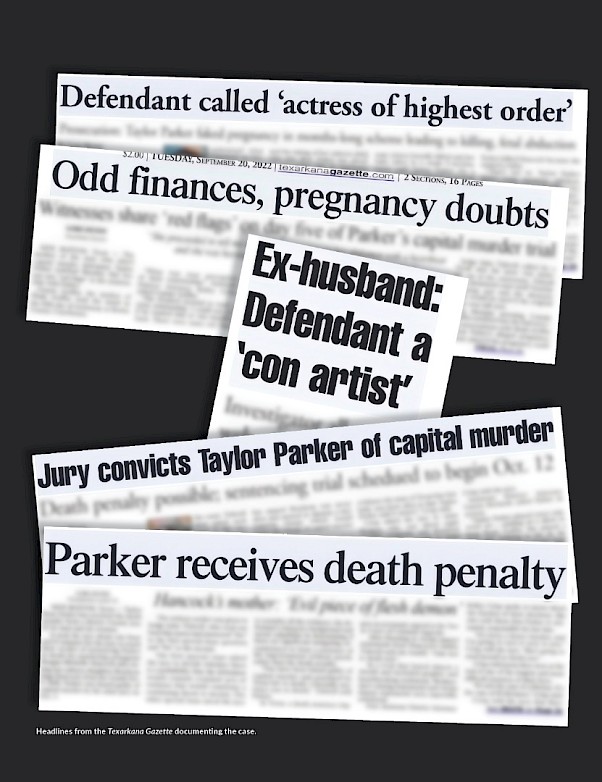
In the months leading up to the crime, Parker faked her own pregnancy, telling friends and family she was expecting a baby. She staged a gender reveal party, shared false ultrasound images, and told others she was scheduled to be induced. On October 9, 2020, Parker went to Hancock’s home in New Boston. Inside the home, she attacked Hancock, forcibly removed her unborn child, and fled the scene with the infant, intending to present the baby as her own.
THE ARREST
A state trooper stopped Parker for speeding and erratic driving. Officers found her covered in dried blood and holding the deceased infant, with the umbilical cord still attached. When Parker was taken to a hospital in Idabel, Oklahoma, medical staff determined she had not given birth.
TRIAL & CONVICTION
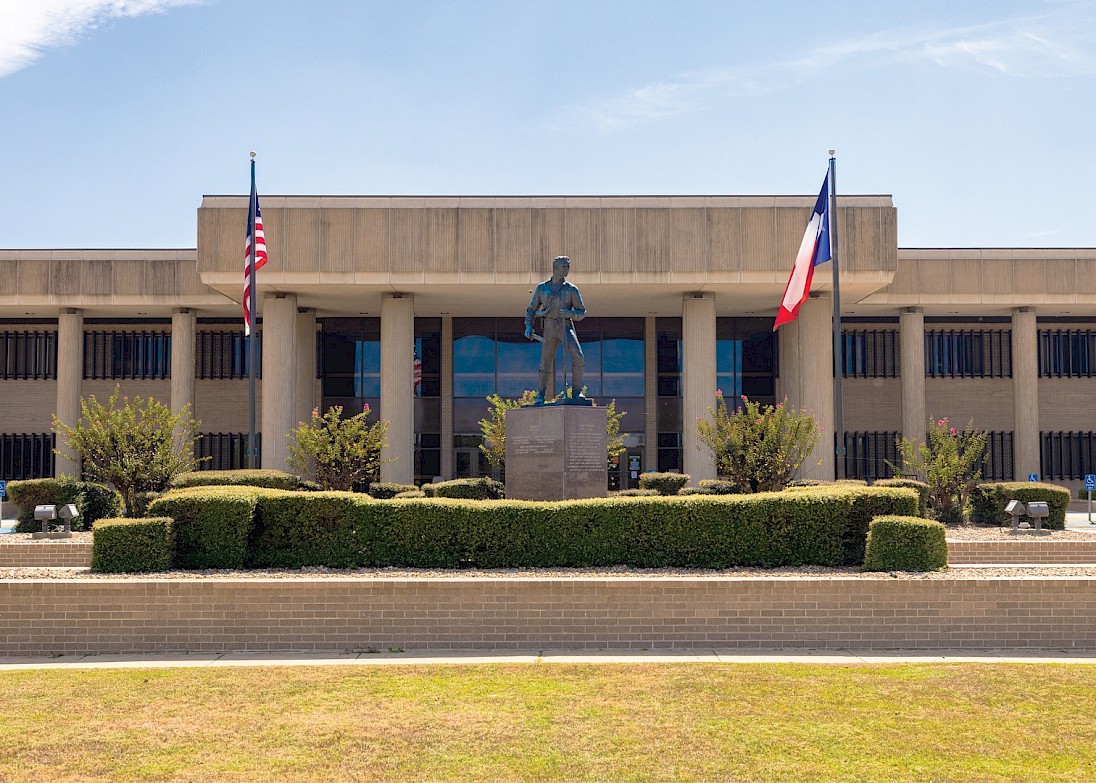
Parker was charged with capital murder. A Bowie County jury convicted her on October 3, 2022. She was sentenced to death on November 9, 2022. The case was prosecuted by Bowie County First Assistant District Attorney Kelley Crisp and her team.
APPEALS
Parker appealed her conviction and death sentence, alleging prosecutorial misconduct. In November 2025, the Texas Court of Criminal Appeals denied the appeal and unanimously affirmed the sentence.
CURRENT STATUS
Parker is incarcerated at the Patrick L. O’Daniel Unit in Gatesville, Texas, where she remains on death row awaiting an execution date.
WHY THIS CASE IS UNIQUE
Parker’s death sentence places her among only seven women on Texas’ death row. Women represent less than 2% of the nation’s death row population, making capital convictions involving female defendants exceptionally rare. The outcome reflects the seriousness with which prosecutors and jurors viewed the circumstances of the crime.
LIFE IN THE AFTER
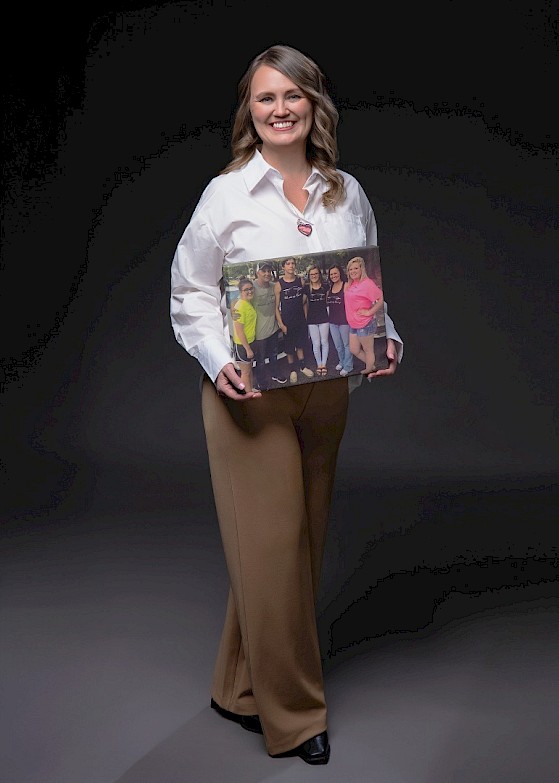
A special thank you to Apricot Lane Boutique for donating the wardrobe worn by Jessica Brookes.
Today, years after the day the world stopped for Jessica's family, not gone “back to normal.” It has moved forward into something else; something different. This family is marked by something unimaginable, and it did change them, but it did not break them. It strengthened their family and brought them even closer together.
Jessica attributes her faith and trust in God for carrying her through the past five years. “There is a constant battle between good and evil in this world that we don’t see,” she said. “And I know that God didn’t do this.” Though the worst days have grown less frequent with time, Jessica says the grief is still very real. Every day, something about Reagan still hits her—an image, a memory, a passing thought, and for a moment, she said, “It will take my breath away.”
Yet even as grief has reshaped her life, Jessica finds that joy still comes. Kynlee, now eight, continues to be a living link to her mother. “Kynlee,” Jessica said with a soft laugh. “Oh, that kid—she’s a mess. She is so much like Reagan.” Jessica sees it everywhere: in Kynlee’s attitude and the way her little nostrils flare when she’s irritated. The resemblance is striking. Kynlee is a reminder not of all that Jessica lost, but of everything that remains. The child who survived that unimaginable day brings life back into the spaces grief once emptied. “We remind her [Kynlee] all the time what a good mommy she had. We would be doing an injustice to Reagan if we didn’t.”
When asked about what she would tell someone else walking through impossible loss, Jessica doesn’t offer anything tidy or neat. She talks about wonderful counseling at the Children’s Advocacy Center. She talks about the importance of not being alone, about talking, and letting yourself grieve. She said, “You’re going to grieve off and on for the rest of your life. You have to let yourself.”
As strong as she is, Jessica says this changed who she was at the core. She says where she used to be more open and welcoming, now she prefers to keep her family circle closed. “I used to be super outgoing. I’d welcome anybody. And now, … I am so cautious.” She doesn’t like the impact it has had on her and the family. “Everybody is suspect, and I hate being that way.” It is not how she was before, and it is not how she raised her kids. “I’m not as kind as I used to be. I’m not as forgiving as I used to be, not as patient as I used to be. Nothing about me is the same, nothing.” “But,” she continued, “that’s life afterwards.”
Crisp feels that divide, too. “There are events in the course of life that mark seasons and serve to divide time—events by which you measure all other occasions. This is one of those life events for me.” Crisp said. “There was before Taylor Parker and then, fortunately, thankfully, after…”
“Reagan was strong; she was a fighter...,” Crisp said. “She loved her family with a fierce loyalty that all of us appreciate. When I think about Reagan, I think about a mother’s love. Which, if you’ve spent any time with Jessica, you know exactly where Reagan learned it.”
Crisp remembers the impact not only on herself and Reagan’s family, but on the community as well. “Bowie County will never be the same,” she said. She still gets regular comments from the public about how this case changed their day-to-day routines. “Women will tell me they didn’t go out alone when they were pregnant, they no longer buy used baby toys or clothes on social media because they won’t meet up with a stranger. The most common comment I get is that people aren’t comfortable sharing the wonderful news of a pregnancy on social media for fear someone will come after them.”
Relationships forged in tragedy carry a different weight than other connections. “There will never be a single day I don’t feel a personal responsibility to Reagan and her family,” Crisp noted. “It is the honor of my lifetime to have served as the lead prosecutor on this case.”
For Cindy, Jessica’s mother, the loss has come in layers. “As a mom,” she said, “one of my biggest fears was losing one of my children.” What made the loss especially crushing was the helplessness that followed. “I’m the Mama,” she said softly. “I’m supposed to fix things.” But this was something no mother could repair. And as a grandmother, the grief was multiplied, mourning her granddaughter and great- granddaughter while watching her own daughter, Jessica, endure an agony she could not take away.
In the days and months that followed, the family leaned heavily on their faith. “God was all we had to depend on,” Cindy said. Yet even in the most profound grief, something unexpected happened: Their circle grew tighter. “It brought our family and friends closer,” she said. Even now, years later, someone will sense when another is struggling. “It’s like we just know,” Cindy said. “We start a group text or a group call.” Their grief, though heavy, became shared, carried together rather than alone.
When Reagan’s younger sister, Emily, got married, the absence was overwhelming. Reagan should have been standing beside her as matron of honor. Instead, the family placed a photograph and a bouquet where Reagan would have been, a silent reminder of their loss. Later, when Emily became pregnant, joy and fear collided. “It was hard to feel excited,” Cindy admitted. Though they never expected another tragedy, the memory of October 9 cast a long shadow.
What surprised Cindy was how healing returned, slowly and quietly, often in ordinary moments. She described a day when she, Jessica, and Emily attended a children’s resale event—something they once did easily, before everything changed. “For the first time in years,” she said, “we let ourselves get excited about baby clothes again.” It was simple, but profound. “That was the most therapeutic thing the three of us had done in five years.”
In November, Emily and the entire family welcomed Haisley Michelle, who brought with her a joy that was previously stolen and filled a deep place in their hearts. Emily gave her daughter Reagan’s middle name in honor and memory of her big sister. It is a reminder that life continues—not by letting go of those we lose, but by carrying them forward.
Reagan Michelle Hancock isn’t confined to the past. She shows up in her daughter, Kynlee, and in the closeness of a family that refuses to let tragedy destroy them. Her absence is unmistakable, but so is her imprint. The blast changed everything, but it did not erase what endures. Reagan’s memory remains in the stories her family tells.
In the years since October 9, 2020, Jessica and her family have learned what it means to live in the after. Life did not return to what it was, and it never will. Instead, they have learned to carry what remains—faith and family. The memory and impact of Reagan’s life were greater than the violence that took her. Reagan’s story is not defined by the details of a crime. It is defined by who she was: steady, loving, funny, tender when it mattered, and a fiercely devoted mother.