A Bountiful Harvest
The Honorable Evelyn Palfrey McKee has lived a life marked by bold moves, resilience, and heart. From her beginnings in Texarkana to a vibrant retirement as a proud grandmother in Oklahoma, McKee’s life reflects courage, perseverance, faith, and a readiness to seize new opportunities.
Born in Arkansas at Dr. Jamison’s hospital—the birthplace of most Black babies in the area at the time—McKee spent much of her life in Texas, holding dear the memories of her childhood in Texarkana. One of her fondest recollections involves time spent fishing with her family at Lake Texarkana (now Wright Patman Lake). “Daddy had a boat, and we sometimes stayed overnight on the lake, my sister and I in pajamas,” she reminisces. The lake became a haven, offering cherished outings with school and church groups when city parks were off-limits to Black families. Those days on the water became priceless treasures, the kind that shape a lifetime.
The beautiful Piney Woods of Northeast Texas hold a dear place in McKee’s heart. So much so that she embraced a tradition of planting a pine tree at each home she owned. Although the soil in Austin did not always cooperate, the ritual symbolized the act of staying connected to her roots and putting them down was a part of making each house a home throughout her journey.
Perhaps the desire to stay grounded and connected to her hometown has to do with the fact that her teachers and family members served as her mentors and role models in life. When reflecting on the influence they had, she says, “Against greater deprivations and resistance than I’ve ever faced, they achieved success in various fields. They included teachers, preachers, principals, social workers, nurses, a chemist, a physicist, a Texas and United States legislator. Even a ne’er-do-well or two served as object lessons. They not only laid the groundwork for me, but insisted that, with determination and hard work, I could do anything that I set my mind to.”
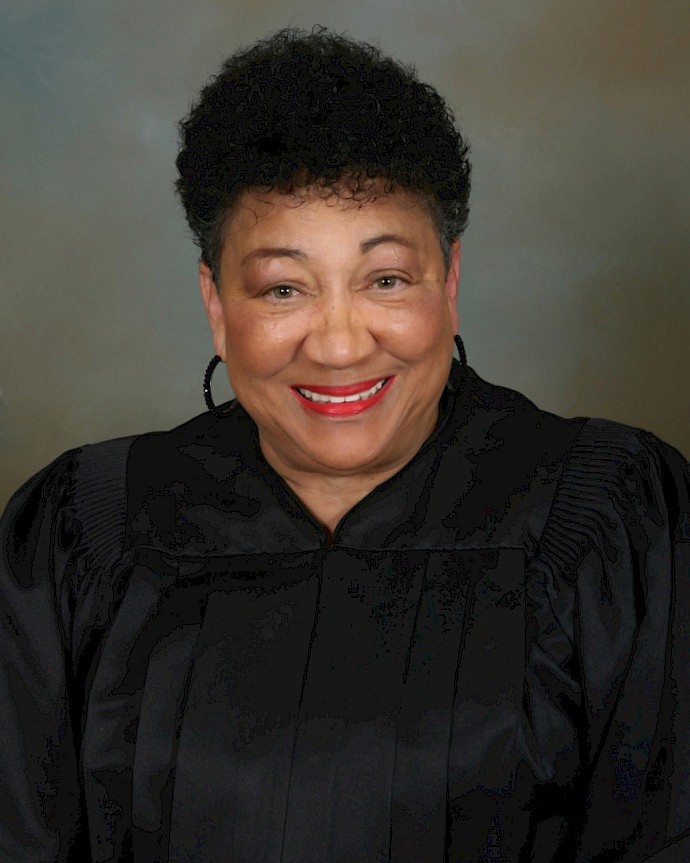
photo by Larch Photography
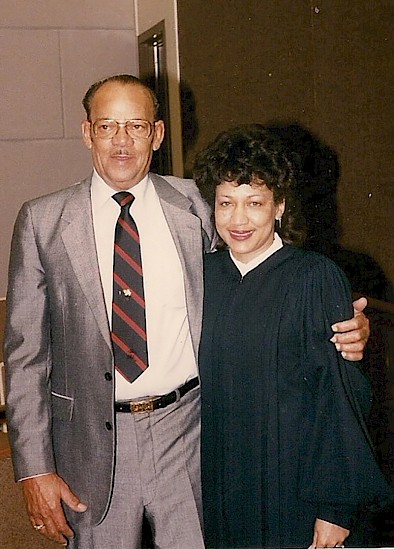
photo courtesy of Evelyn Palfrey McKee
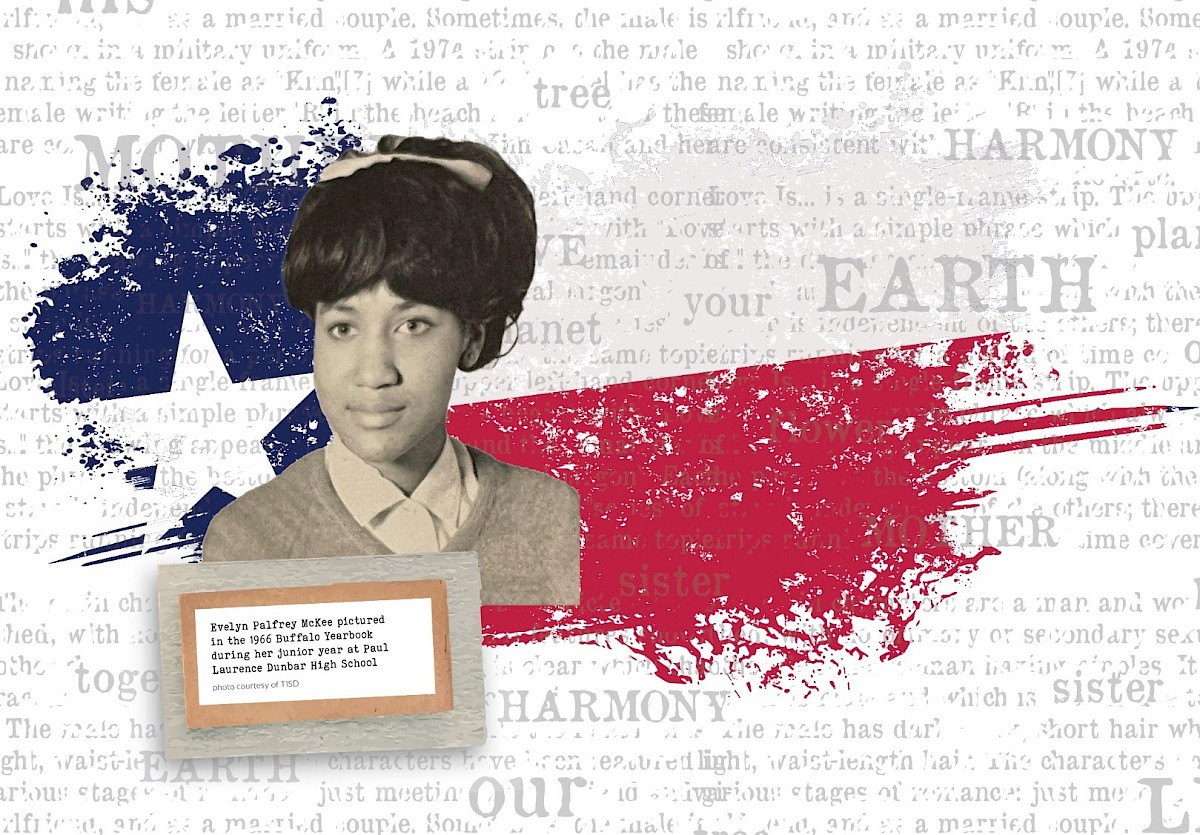
Following in the footsteps of her mother and her mother’s siblings, McKee attended Paul Lawrence Dunbar, the all-Black school in Texarkana, Texas, before relocating during her junior year when her father’s job required a move. Despite not graduating from Dunbar High School, her loyalty to the school remained steadfast. Over the years, when the Dunbar reunion conflicted with that of the Catholic school she attended for her senior year, McKee always chose Dunbar, missing only one or two reunions in half a century. She remembers her time at Dunbar with great fondness. “At Dunbar, my grades were based purely on merit—not race,” she says. “Those were times I didn’t have to question the fairness of my grades. They reflected the effort that I had put into the material and nothing else.”
“Dunbar had its own stadium, so our football games were on Friday nights. In many towns, the Black school had games on Thursday nights in the ‘white’ stadium, as Friday nights were reserved for the white school. Michael Hurd, a Texarkana native and sportswriter for large periodicals, wrote a book called Thursday Night Lights about those times,” she explained.
McKee was fortunate to have taken piano lessons and could read music. Going into seventh grade, her parents gifted her with a flute and a book. “You can teach yourself to play the flute,” they said. She became active in the band and was a majorette, a role she loved. However, she recalls less glamorous moments, like marching behind horses in the Four States Fair Parade. “The experience put some steel in my spine that allowed me to recognize and resist intentional, or thoughtless, cruelty for the rest of my life.”
Recently, McKee was thrilled to be honored as a TISD Distinguished Alumni. Imagine her joy in having her second-grade teacher, Mrs. Essie Dodd, and many former schoolmates present at the ceremony! Judge McKee was very impressed with the festivities coordinated by Shawn Edmonds and the plans Superintendent Brubaker laid out for the new Dunbar campus and the improvement of Texas High. She notes that, in her experience, the time between bond approval and the opening of new facilities has often been significantly longer in other places.
Because of the move at the end of her junior year, McKee was not in TISD during integration. She attended a small Catholic school where the majority of students were white. She then went to a small Catholic college before attending Southern Methodist University (SMU) for her post-secondary studies. According to McKee, “SMU allowed Black students into theology school in 1951. The undergraduate school did not allow integration until 1962,” she explained. “By 1968, when she arrived, around 30 Black students were among the 10,000-student body.”
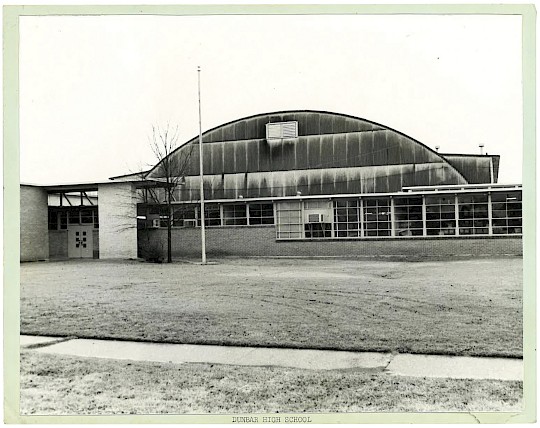
photo courtesy of TISD
Attending the small Catholic schools where most students were white helped with the transition to SMU, with the size of the student body being the only difference. She mentioned that most of the administrators and professors were welcoming or at least fair, but aside from a few friends she made, the white students treated the Black students as invisible. She recalls she never felt threatened or experienced hostility on campus but admitted that between her studies and a part-time job, she may not have had time to notice.
McKee recalls the strong fraternity and sorority culture at SMU—organizations that made it clear they would not “desegregate.” Regarding this era, she said, “But remember, these were tumultuous years of public school integration, murder of Black leaders, the rise of hippie culture and Woodstock, protests against the war in Vietnam, and the murder of a Kent State student protester by a National Guardsman. At SMU, we had a lot more on our minds than joining folk parading around in Antebellum costumes and waving Confederate flags.”
After graduating from SMU, McKee moved to Austin, where she built her career and life from 1971 to 2022. With her degree from a respected university, she initially worked several jobs, garnering life experiences, such as a short-order cook, a secretary, a cashier at a cleaners, and a state employee. It was during this period that she pursued a law degree. She chose a law profession because “There is a saying (probably just among lawyers) that while lawyers were writing the Constitution, doctors were treating people with leeches. But the real deal is I had not taken enough undergraduate science to consider med school. Besides, Black lawyers were prominent in pushing for civil rights, and there was a law school right there in Austin.”
Throughout her years of service in law, McKee held different positions within the profession. She began as an assistant county attorney, managing county contracts, and later opened her own private practice specializing in probate and family law. In 1989, she was appointed as a substitute judge on the Municipal Court, transitioning to a full-time judge in 1992. By 1999, McKee was appointed as Presiding Judge, a role in which she oversaw 20 judges and 150 clerks, demonstrating her leadership and organizational skills. “It was a pretty heavy responsibility, balancing the interests of the employees, the public, law enforcement, and the Bar. I like to think that I carried it with sincerity and aplomb.” She also served on several boards and commissions, including the State Bar of Texas Board of Directors.
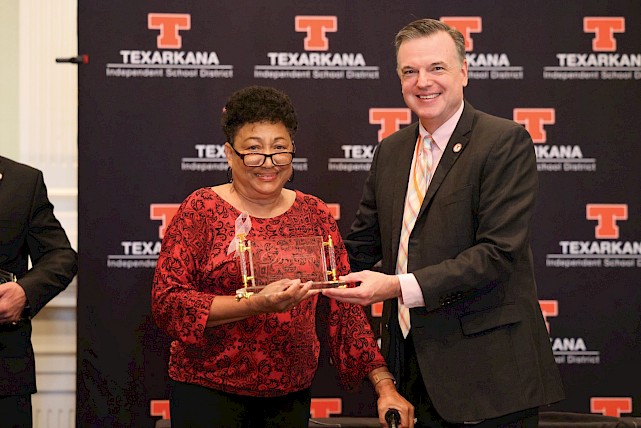
photos courtesy of TISD
An avid reader all her life, McKee loves books, especially romance novels. But between school, work, and family, there was a time when she took leave from reading for pleasure. When she picked it up again at 45, she realized she was no longer interested in romance novels because the characters were the age of her children. This spurred her to write her own stories that would refuel her interest, and it turns out there was an entire audience who longed for stories that had characters they could identify with—as McKee calls them, the “marvelously mature.” This “marvelously mature” audience embraced her so fully that five of her novels were published, and one of them, The Price of Passion, was named a #1 Essence Magazine best-seller.
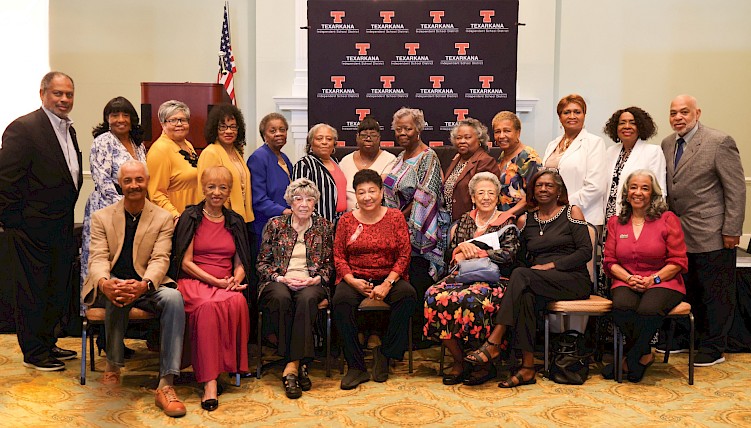
photo courtesy of TISD
“I think there were other readers like me, with a little roundness in places that used to be flat. They were yearning for stories about them, the conflicts in their lives, and in the end, a hero with a little gray at the temple.” Inspiration for these novels came from life—from her life and the lives of others. “Everyone has an interesting life,” she said, “with a measure of joy and sorrow.”
In addition to her romance novels, McKee contributed to two Chicken Soup for the Soul books, both honoring women. She explained, “The Lady at the Bus Stop was a tribute to the women who went before me, who faced extreme obstacles, and who pressed me to move forward with grace and humility and build on the foundation they laid. Mama’s Hands was a tribute to mothers who gave up their dreams so that their daughters could achieve theirs.”
While managing the responsibilities of family and a thriving law career, McKee kept the balance by “putting one foot in front of the other and doing the next thing that needed to be done.” She traveled extensively and loved it. She also enjoyed being in bookstores throughout the country among intelligent, accomplished reading women, and she never passed up an opportunity to speak at schools.
Throughout her life, McKee has found fulfillment and joy in gardening, or as she says, “playing in the dirt.” “In the garden, I feel close to God. I can take one seed, add some blood, sweat, and tears, and reap a bountiful harvest to use and share. I believe that is what He wants us to do—especially the sweat and share parts.”
Her pine trees may not have thrived, but her legacy—rooted in service, literature, and the communities she touched—grows tall and strong. Her advice to others about overcoming obstacles and pursuing their dreams would be, “Be persistent. Make them tell you no—until they tell you yes. Be brave, even when you don’t feel it. In the end, no matter what, unlike the lion to the wildebeest, they can’t eat you.”