Why I Hike
The point is not mileage, but momentum."
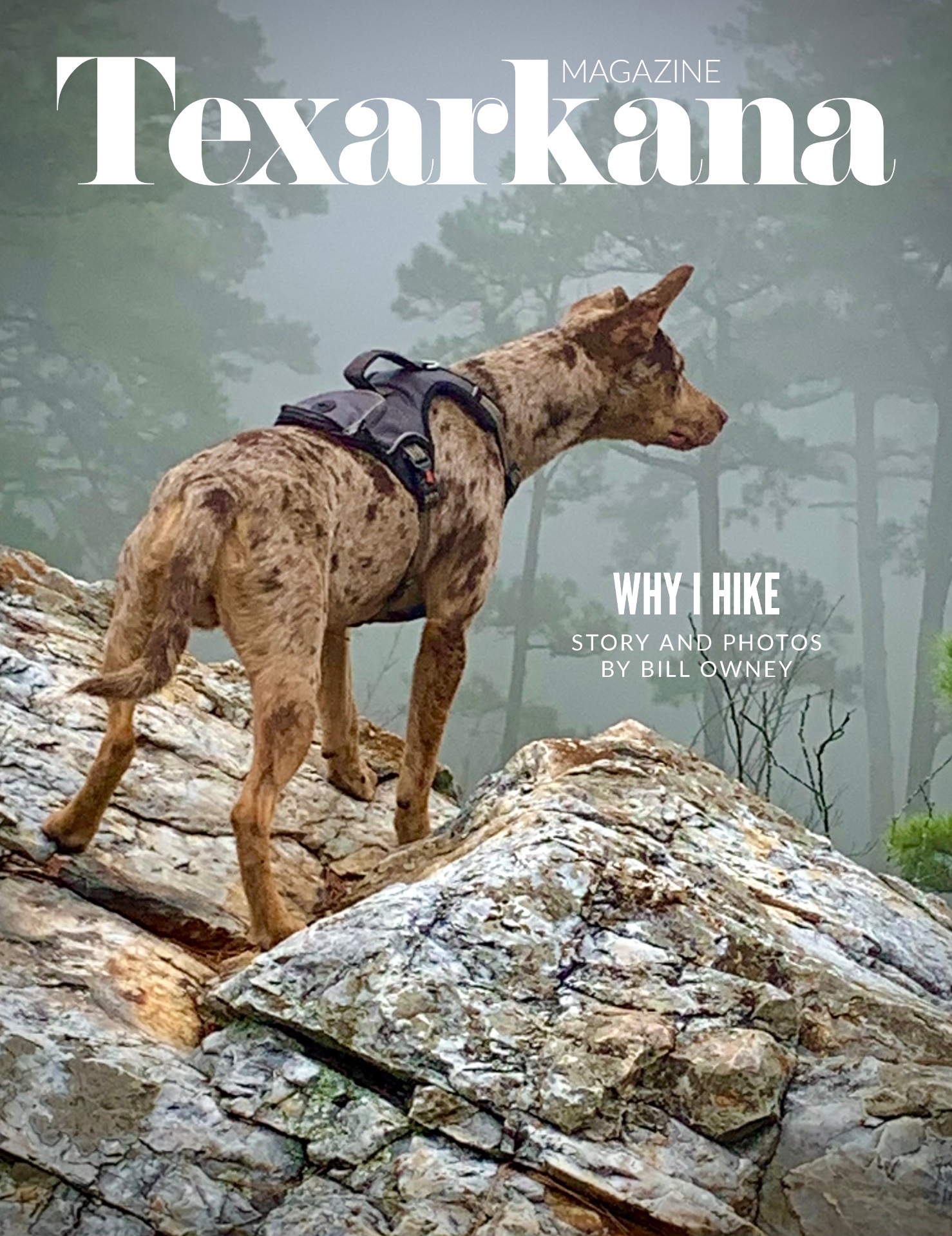
Sleet hissed through barren trees, fog wrapping the wetlands in mystery. Thunder rolled in the distance, heralding the cold front's approach. I pulled up my hood and zipped my jacket, cocooned against the chill, while my dog, Moo, bounded ahead along the abandoned stretch of Old Highway 71.
Ashley Camp Road lies forgotten most days, a thin trail marking the path where commerce once flowed through southwestern Arkansas. Fallen leaves carpet the concrete, softening each step. No loose rocks to twist ankles, no hidden roots to trip feet—just a quiet, steady walkway through the forest.
I love the challenge of steep climbs and the breathtaking Ouachita views from narrow, cliff-top trails, but flat is good, too. Though I will soon be 75, I walked fast, double my normal trail rate, and covered eight miles in two hours. Moo covered twice that, splashing through swamp ponds and muddy creeks like a wild spirit unleashed. His brand-new holiday sweater was soon filthy and soaked.
"Fa, la, la-ha!" I laughed, realizing joy is not measured in miles but in moments.
Vitality and the Brain
Vitality can be joyous and sleet-defying, but it is not accidental. It is the fruit of what I have learned at the intersection of faith, neuroscience, and aging. Cambridge researchers describe lifelong brain development in five epochs: childhood's explosive synapse growth, adolescence's drive for efficiency, adulthood's consolidation of stability, early aging's turn toward pruning and selectivity, and late aging's refined reliance on specific regions.
New research illuminates this shift, suggesting the brain isn't merely losing connections but actively optimizing its networks. A key structure, the claustrum—a thin neuronal sheet deep in the brain—acts as a conductor, coordinating activity for focused attention. Lifestyle, it seems, can bolster this "cognitive reserve," enhancing the brain's ability to maintain integrated, efficient networks as we age.
This purposeful pruning—the system streamlining itself for what remains—defines my fourth epoch, where depth matters more than breadth. Where once I longed for a night on the town, now an intimate dinner with Blue-eyed Beauty more than suffices.
The younger me was blessed with insatiable intellectual curiosity. Now that same drive focuses on meaningful themes: faith, mortality, wisdom, storytelling. Hiking is how I live into this epoch—choosing rhythm over noise, depth over distraction.
Hiking as Brainwork
Since marrying Beautiful Bride a decade ago, I have lost 120 pounds and, with my doctors' guidance, reversed heart disease and put diabetes into remission. Hello, new knee. Goodbye, insulin. Gone, too, are the "-itises"—tendonitis, arthritis.
Those gains came from surgery, drugs, and fundamental shifts in every part of my life. My physician, Dr. Matt Ramage, and the team of specialists he summoned to save my life agree that my most potent medicine was fitness. To me, hiking is more than exercise. It is careful nourishment, enforced rest, and moving meditation rolled into one practice.
We all understand that children need nourishment, rhythm, and stimulation for their brains to grow. Parents guard sleep schedules, pack lunches with nutrients, and encourage play because they know these habits shape the brain. Yet we somehow think those same practices magically stop mattering once we reach adulthood.
The truth is that lifestyle choices have both quantitative effects—measurable changes in brain volume, connectivity, efficiency—and qualitative effects—emotional regulation, resilience, clarity—across every epoch. Exercise boosts hippocampal growth in elders. Meditation thickens gray matter even in late life. Sleep continues to consolidate memory at every age. Hiking is my way of keeping those practices alive.
When I lace up my boots and head to the trail, I am not chasing longevity. I am chasing vitality. I am going to die when I die—something will get me. Hiking keeps me independent, productive, joyful, and healthy. It keeps me attentive to Moo's bounding joy, to the sleet sizzling through the trees, to the fog that wraps the wetlands in mystery, to the magic of virgin forests.
The Disconnect of Epochs
In the years of stressful jobs, I was a gym rat, albeit an obese one. The weight room was my refuge, and when the "widow maker" artery became 90% clogged, it was the primary reason I survived a scary afternoon in the St. Michael Hospital emergency room and a week in cardiac intensive care.
When I found myself with more doctors' appointments than dates with Blonde Beauty, fitness became both a strategy and refuge. Then COVID closed the gyms and drove me to the trails. What began as a necessity became revelation: hiking was not just exercise, but restoration—a way to nourish body, mind, and spirit all at once.
As I journey into this fourth epoch, I've learned that vitality is not accidental. It comes from movement, resilience, and faith. It is foundational to a healthy, evolving brain.
Younger friends, wired for achievement and breadth, may not see the terrain that only emerges later in life. Their stage is about building; mine is about pruning and deepening. What may seem like ageism is simply different perspectives shaped by the brain's seasons.
Out here, on the trail, I see that pruning is not loss but refinement. Wisdom is not about being heard, but about being faithful. Hiking reminds me that vitality is a choice—one step, one breath, one heartbeat at a time.
Thirty miles a week is my rhythm, but regular movement in any form is magic. Ten minutes a day—a walk around the block, stretching, light chores—is enough to begin preserving the freedom of mobility and self-reliance. The point is not mileage, but momentum.
Seasonal Lessons
Whether on early morning hikes to escape Texas' summer heat, or late afternoon fall ones to witness rich leaves made luminous by the setting sun, I go to the woods to escape the noises of angry voices that forget it is not the thunder, but the rain, that makes the flowers grow.
Out here, silence speaks louder than argument. Out here, rhythm replaces rhetoric.
Some see God in nature. I see that God is nature because it continuously gives vent to the miracle of life that tells the tiniest of cells to grow into massive structures. How do two microscopic cells contain all the information needed to create a human being? When we see in nature the persistence of life—that fallen leaves only pretend to be dead, that snow and ice are spring's cradle, that even a cloud never dies—we behold our Creator. Hiking is my way of listening to that persistence, of honoring the relentless magic of life itself.
Like nature itself, our brains prune and renew, teaching us that endings are beginnings.
Vitality Over Longevity
So, my framework is simple: vitality over longevity. To live well is to live productively, joyfully, and faithfully in whatever years remain. To live well is to honor the architecture of the brain and the indefatigable stamina of faith, both of which remind us that life is not about endless extension but about meaningful presence.
That is why I hike. Not to live longer, but to live well longer. Hiking is my antidote to the factory model of life—the endless schedules, the programs, the committees. Out here, there are no quotas, hierarchies, or deadlines. Out here, there is only rhythm: breath, stride, heartbeat. Only silence. And peace.